Free PDF The Book of Disquiet (Penguin Classics), by Fernando Pessoa
The Book Of Disquiet (Penguin Classics), By Fernando Pessoa. In undertaking this life, many individuals consistently aim to do and obtain the very best. New expertise, experience, session, and also everything that could enhance the life will certainly be done. Nevertheless, many individuals often feel confused to obtain those things. Feeling the minimal of encounter and sources to be far better is among the lacks to possess. However, there is a quite simple thing that can be done. This is exactly what your educator constantly manoeuvres you to do this one. Yeah, reading is the response. Checking out an e-book as this The Book Of Disquiet (Penguin Classics), By Fernando Pessoa and also various other referrals could enhance your life quality. Just how can it be?
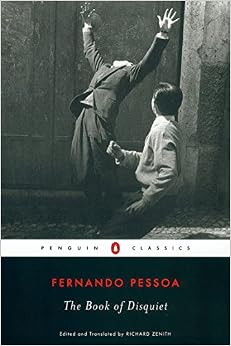
The Book of Disquiet (Penguin Classics), by Fernando Pessoa

Free PDF The Book of Disquiet (Penguin Classics), by Fernando Pessoa
Do you recognize just what the advantages of reading are? Before discussing concerning The Book Of Disquiet (Penguin Classics), By Fernando Pessoa, we will certainly ask you initially. Just what do you obtain after reviewing? What do you obtain after completing checking out a publication? Exactly what's your feeling? Well, a lot of concerns we will certainly utter to you, the remarkable book fan, as well as visitors. We mean you to be outstanding because in this contemporary period, many people choose to talk with other to reading. This is why, the reasons of how guides ought to be cultured are essential.
The reason of why you can obtain and get this The Book Of Disquiet (Penguin Classics), By Fernando Pessoa quicker is that this is the book in soft data kind. You can check out the books The Book Of Disquiet (Penguin Classics), By Fernando Pessoa anywhere you really want even you are in the bus, office, home, and other places. But, you might not have to move or bring the book The Book Of Disquiet (Penguin Classics), By Fernando Pessoa print wherever you go. So, you won't have larger bag to lug. This is why your option making better concept of reading The Book Of Disquiet (Penguin Classics), By Fernando Pessoa is really practical from this instance.
The reasons might not huge ideas for reading a book to review when remaining in leisure. It will additionally not should be so sensible in undertaking the life. When you need to most likely to the other places as well as have no suggestions to obtain guide, you could find lots of soft file of the book in the internet site that we show here. As for getting the The Book Of Disquiet (Penguin Classics), By Fernando Pessoa, you could not need to go to the book shop. This is the time for you to conserve guide soft documents in your device then bring it almost everywhere you will go.
Preserving the practice for reading is often hard. There will be many challenges to really feel bored quickly when reading. Several friends could pick chatting or going somewhere with the others. Checking out The Book Of Disquiet (Penguin Classics), By Fernando Pessoa will certainly make other individuals feel that you are an extremely publication fan. Nonetheless, the one that reads this publication will certainly not constantly mean as publication lover.
The means you read this publication will certainly depend on exactly how you stare and consider it. Lots of people will certainly have their minutes and particular to contrast as well as take into consideration concerning guide. When you have the concepts to find out with the book written by this specialist author, you can have benefits of it. The Book Of Disquiet (Penguin Classics), By Fernando Pessoa prepares to get in soft file. So, find your ideal reading publication today and you will certainly get actually exactly what you expect.
The prizewinning, complete and unabridged translation—“the best English-language version we are likely to see for a long time, if ever” (The Guardian)—of a work of unclassifiable genius: the crowning achievement of Portugal’s modern master Winner of the Calouste Gulbenkian Translation Prize for Portuguese Translation Fernando Pessoa was many writers in one. He attributed his prolific writings to a wide range of alternate selves, each of which had a distinct biography, ideology, and horoscope. When he died in 1935, Pessoa left behind a trunk filled with unfinished and unpublished writings, among which were the remarkable pages that make up his posthumous masterpiece, The Book of Disquiet, an astonishing work that, in George Steiner's words, "gives to Lisbon the haunting spell of Joyce's Dublin or Kafka's Prague." Published for the first time some fifty years after his death, this unique collection of short, aphoristic paragraphs comprises the "autobiography" of Bernardo Soares, one of Pessoa's alternate selves. Part intimate diary, part prose poetry, part descriptive narrative, captivatingly translated by Richard Zenith, The Book of Disquiet is one of the greatest works of the twentieth century.
Product details
Series: Penguin Classics (Book 236)
Paperback: 544 pages
Publisher: Penguin Classics; New Ed edition (December 31, 2002)
Language: English
ISBN-10: 0141183047
ISBN-13: 978-0141183046
Product Dimensions:
5.1 x 0.9 x 7.7 inches
Shipping Weight: 13.4 ounces (View shipping rates and policies)
Average Customer Review:
4.4 out of 5 stars
144 customer reviews
Amazon Best Sellers Rank:
#59,818 in Books (See Top 100 in Books)
The Book of Disquiet, written by Fernando Pessoa, a Portuguese poet, is considered an early classic of existential writing. I’ve been drawn to existentialism — which I understand to be the recognition that life lacks meaning, rendering the human condition a function of mere existence — since reading Sartre, Camus and Kierkegaard years ago. There’s a dizzying, and occasionally terrifying and paralyzing kind of freedom that comes with accepting there is no externally imposed or internally accessible grand purpose. And so it falls to each of us stare unflinching into the void, steady our nerves, and then get busy creating and maintaining a consistent sense of meaning to guide and sustain our lives.Pessoa explores these themes in a unique, memorable and effective way. Apparently, he wrote using a variety of pseudonyms — or semi heteronyms, whatever that means, according to the foreword — both as an artistic statement and, I presume, as a means of putting some space between his writing and his own filters and experiences. The Book of Disquiet is “written†by one of his personas, Bernardo Soares, an assistant bookkeeper in an inconsequential office, as a diary or journal of ruminations on a life that, by his own admission, is truly not worthy of ruminating about. The guiding force is page after page of Soares — uneasy that he is even alive — thinking about what it means to think, to feel, to live, to exist and to work. It is a disquieting exploration of what it means to be human, and what it means to exist, from someone who seems almost disappointed that he is human and does exist.Soares is content to move through life — his own and the world around him — as a reluctant observer, focused on his own reactions to reacting, and grounded in his experiences of experiencing, his own feelings at feeling, with only his incomplete senses serving as a somewhat reliable source of truth in a world billowing with half truths. And that truth, for him, is that even with only the most fleeting of closer looks, life is absurd and those of who stride boldly through the world with a sense of purpose are mistaken and misguided. In today’s world, Soares would probably be considered a depressive, asexual narcoleptic — and likely be highly medicated — but in this book, he becomes a champion of reacting rationally and effectively to the truth of existential despair — that is, by embracing the notion that nothing matters and living a specific life that mirrors, and celebrates, the meaningless of all life.It was a grinding slog, reading the musings of a (created) man constantly questioning what it means to be human, and finding the answer in his ability to find no answers. But that doesn’t mean I didn’t find it accurate, and moving. For me, no other author has so successfully captured the disorienting liberty of existentialism. And, because the “real†author was an accomplished poet, the almost monotonous reflections on reflecting, the most minute observations on his sensory observations, glittered with powerful, lyrical lines that literally caused me to put the book down and close my eyes, just so I could think about them longer undisturbed. Lines like these:“If the heart could think it would stop beating.In modern life the world belongs to the stupid, the insensitive and the disturbed.I envy in everyone the fact that they are not me.What would become of the world if we were human? If man really felt, there would be no civilization.To know oneself is to err.The life one lives is one long misunderstanding, a happy medium between a greatness that does not exist and a happiness that cannot exist.I’m just the bridge between what I do not have and what I do not want.Leadership requires insensitivity. Only the happy govern because to be sad it is necessary to feel.What has happened to us has either happened to everyone or to us alone; if the former it has no novelty value and if the latter it will be incomprehensible. I write down what I feel in order to lower the fever of feeling. What I confess is of no importance because nothing is of any importance. I make landscapes out of what I feel. I make a holiday of sensation.… the insatiable, unquantifiable longing to be both the same and other.Action is a disease of thought, a cancer of the imagination.â€The Book of Disquiet may not be for everyone, but it’s a tremendous journey into the heart of self-doubt that powers existentialism, the self-doubt that — if we’re as honest as the dishonest (manufactured) Soares — constantly lurks just below the surface of life.
Reader Beware - Amazon has followed its usual procedure of cobbling reviews for three totally different editions of the same book together. After having read all the reviews of this book, one could get a good idea of what Pessoa is all about (he's not for everybody), but get a distorted idea of this particular edition. But first - there are other issues I’m surprised no one mentioned. The first is the hideously ugly cover. In no way does it have any connection with the contents or induce the reader to buy the book, which, after all, is the purpose of a front panel design. Next - this new ‘complete edition.’ Can any edition be complete? The text was put together by the editor from papers that were found after Pessoa’s death. I know of three different versions in English, all very different, all put together from papers found after Pessoa’s death. My discovery of the book was the Richard Zenith translation available as a Penquin Classic. I’m not qualified to compare translations from the Portuguese and that’s not really an issue here. The version under revue has different texts than the Zenith version. It starts with a different narrator, who is not in the Zenith edition at all, and radically alters the conception of what readers heretofore thought was the Pessoa they knew. Well about half of the Pizzaro/Costa isn’t the same as the Richard Zenith book. The editor/translator says that Pessoa’s posthumous papers included this second narrator and should be included. Perhaps. But the Zenith edition is cohesive while this edition, presenting two narrators who presumably are the same person (but couldn’t be, having different sensibilities), makes this version confusing and unsatisfying. Part one of that Pizzaro includes is painful to read and had I come across this as my introduction to Pessoa I would have forgotten his name. Have I belabored this point? It needs belaboring.A third edition from Maria Jose de Lancastre and translated by Costa, published by Serpent’s Tail in 1991, exists. It’s text is similar to Zenith’s but much abbreviated. Zenith’s edition, published in 2001, supersedes it.Pessoa's poetry is best left un-translated, as is all poetry from other languages. But that's just my opinion! If you loved 'Disquiet' you'll like 'The Education of the Stoic."Addition to above review: I just reread my review at a later date. It may not immediately be clear but my review is not for the Zenith translation. I would give the Zenith translation 100 stars (or realistically, five). The Pizarro-Costa edition published by New Directions, being the one my review was written for, deserves one star.
Now and then a book of creative genius floats up out of the ocean of literature. This is one of those special books, in this case the Joyce or Kafka of Portugal who never published during his lifetime. Now we have this jewel of reflective thoughts and feelings about the imaginative writer's life, his opinions on world literature, his thoughts on literally everything in his quiet reflective life. It's an inner journey into the mind of a literary genius who shares his thoughts and insights in a journal of meditations. Pessoa was a man of solitude and loneliness but he was not miserable overall. He worked at an office job and wrote many books and stories under various pennames who were different personalities with their own literary styles. Most of what he wrote was not published in his lifetime and this protected him from the distractions of literary fame. Sample the book first and if it doesn't draw you into his reflective literary world on life's ups and downs, move on; but if you are drawn immediately into his thinking and feeling about life and literature and the joys of solitude and anonymity, you will want to read the entire wondrous gift of this complex solitary philosopher of the life of the storytelling artist. It's truly a lifetime gift for those who enjoy the pleasures of being an introvert and student of human experience. Try it. You'll know almost immediately this book will be a friend for life, solace for the quiet meditative times. As a writer I was charmed in an instant. Like dipping into a deep complex beautiful happy sad diary of a human singularity, a literary genius quietly reawakening his life's most poignant thoughts and feelings about a beautiful mind that has come and gone and left this gift of remembrances and reflections.
The Book of Disquiet (Penguin Classics), by Fernando Pessoa PDF
The Book of Disquiet (Penguin Classics), by Fernando Pessoa EPub
The Book of Disquiet (Penguin Classics), by Fernando Pessoa Doc
The Book of Disquiet (Penguin Classics), by Fernando Pessoa iBooks
The Book of Disquiet (Penguin Classics), by Fernando Pessoa rtf
The Book of Disquiet (Penguin Classics), by Fernando Pessoa Mobipocket
The Book of Disquiet (Penguin Classics), by Fernando Pessoa Kindle